
TEAS Chemistry Practice Questions with Answers
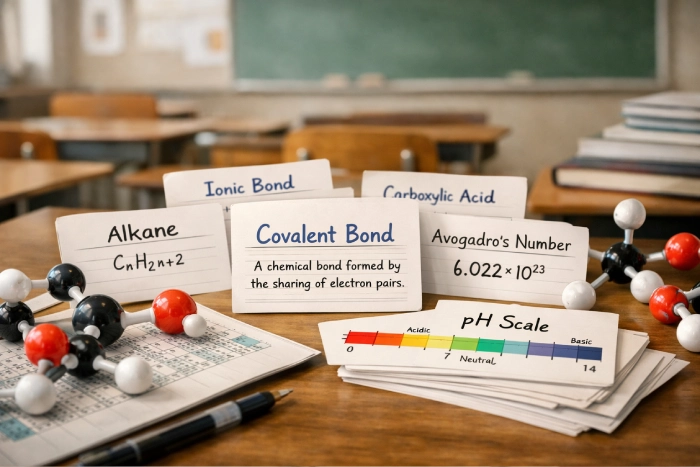
TEAS chemistry practice questions with answers are one of the best ways to prepare for the ATI TEAS 7 Science section. Chemistry is one of the four sections, along with Anatomy and Physiology, Biology, and Science Reasoning, in which most students struggle. The TEAS Science section includes approximately 8 scored chemistry questions covering essential topics.
This practice test set provides realistic ATI TEAS chemistry questions with explanations so nursing program applicants can identify their weak areas before the test day. Students who want additional support can get TEAS 7 chemistry review from Take My TEAS Exam homepage.
What Does the TEAS Chemistry Section Cover?
The TEAS Chemistry section tests foundational concepts rather than advanced chemistry topics and calculations. A strong TEAS chemistry study guide should focus on the topics that appear more often, including:
- Basic atomic structure
- Properties and changes of matter
- Chemical bonds
- Chemical solutions
- Chemical reactions and reaction rates
- Acids and bases
Students should understand concepts such as protons, neutrons, electrons, elements, compounds, substances, ionic and covalent bonds, and pH as well. Chemistry questions are often based on applying concepts rather than memorizing definitions.
The TEAS section also includes areas such as Biology, so if students want to explore additional science topics they can search “How to Master Biology Concepts for the TEAS Exam”, and do their preparation accordingly.
TEAS Chemistry Practice Questions with Answers
Prepare for the TEAS chemistry test with these practice questions and answers. Test your knowledge of atoms, bonds, reactions, acids, and bases with examples.
TEAS periodic table questions & Atomic Structure (Practice Questions 1-4)
Question 1: Which subatomic particle determines the atomic number of an element?
- Electron
- Neutron
- Proton
- Ion
Correct Answer: C. Proton
The atomic number represents the number of protons found in an atom’s nucleus. Every element has a unique number of protons that identifies it.
Question 2: An atom contains 6 protons and 8 neutrons. What is its mass number?
- 2
- 6
- 8
- 14
Correct Answer: D. 14
The mass number equals the total number of protons and neutrons. Therefore, 6 + 8 = 14.
Question 3: Which statement correctly describes isotopes?
- They have different numbers of protons
- They have different numbers of neutrons
- They have different chemical symbols
- They contain different elements
Correct Answer: B. They have different numbers of neutrons
Isotopes are atoms of the same element with identical proton numbers but different neutron numbers, causing different atomic masses.
Question 4: Which group of elements generally contains substances that are good conductors of electricity?
- Nonmetals
- Noble gases
- Metals
- Halogens
Correct Answer: C. Metals
Metals typically conduct electricity because their electrons can move freely. This property makes them useful in electrical applications.
States and Properties of Matter (Practice Questions 5-8)
Question 5: Which state of matter has a definite volume but takes the shape of its container?
- Solid
- Liquid
- Gas
- Plasma
Correct Answer: B. Liquid
Liquids have particles that can move freely while remaining close together. They maintain volume but do not have a fixed shape.
Question 6: Which process changes a liquid into a gas?
- Freezing
- Condensation
- Evaporation
- Melting
Correct Answer: C. Evaporation
Evaporation occurs when liquid particles gain enough energy to escape into the gas phase.
Question 7: A substance has a mass of 40 grams and a volume of 10 mL. What is its density?
- 2 g/mL
- 4 g/mL
- 10 g/mL
- 50 g/mL
Correct Answer: B. 4 g/mL
Density is calculated by dividing mass by volume: 40 ÷ 10 = 4 g/mL. Density calculations are common in TEAS chemistry questions.
Question 8: Which is an example of a chemical change?
- Cutting paper
- Melting ice
- Dissolving sugar
- Rust formation
Correct Answer: D. Rust formation
Rust formation creates a new substance through a chemical reaction between iron and oxygen. Physical changes do not produce new substances.
TEAS chemical bonds practice questions (Practice Questions 9-12)
Question 9: Which type of bond forms when electrons are transferred from one atom to another?
- Covalent bond
- Hydrogen bond
- Ionic bond
- Metallic bond
Correct Answer: C. Ionic bond
Ionic bonds occur when one atom transfers electrons to another, creating positively and negatively charged ions that attract each other.
Question 10: Which type of bond involves atoms sharing electrons?
- Ionic bond
- Covalent bond
- Nuclear bond
- Metallic bond
Correct Answer: B. Covalent bond
Covalent bonds form when atoms share electrons. This type of bonding is common in molecules such as water and carbon dioxide.
Question 11: In a solution, the substance being dissolved is called the:
- Solvent
- Solute
- Mixture
- Catalyst
Correct Answer: B. Solute
The solute is the substance dissolved in a solution, while the solvent is the substance that dissolves it. For example, salt is the solute in saltwater.
Question 12: What happens to a solution when more solute is added without increasing the solvent amount?
- The concentration decreases
- The solution becomes more concentrated
- The solution becomes neutral
- The solvent disappears.
Correct Answer: B. The solution becomes more concentrated
Adding more solute increases the amount of dissolved material compared with the solvent, causing the concentration to rise.
TEAS acids and bases practice questions (Practice Questions 13-16)
Question 13: Which equation is correctly balanced?
- H₂ + O₂ → H₂O
- 2H₂ + O₂ → 2H₂O
- H₂ + O₂ → H₂O₂
- H₂ + 2O₂ → H₂O
Correct Answer: B. 2H₂ + O₂ → 2H₂O
A balanced chemical equation has the same number of each type of atom on both sides. This follows the law of conservation of mass.
Question 14: Which factor can increase the rate of a chemical reaction?
- Lowering temperature
- Decreasing reactant concentration
- Adding a catalyst
- Removing reactants
Correct Answer: C. Adding a catalyst
Catalysts speed up chemical reactions by lowering the activation energy needed for the reaction to occur.
Question 15: A solution with a pH of 3 is:
- Neutral
- Basic
- Acidic
- A salt
Correct Answer: C. Acidic
The pH scale ranges from 0 to 14. Values below 7 are acidic, while values above 7 are basic.
Question 16: Which substance is considered a strong base?
- Hydrochloric acid
- Sodium hydroxide
- Pure water
- Carbon dioxide
Correct Answer: B. Sodium hydroxide
Sodium hydroxide releases hydroxide ions in water, making it a strong base with a high pH value.
These practice tests would be enough for you to get to know how the chemistry section will come; if you still want additional guidance, you can look for a reliable Online TEAS Practice Test as well.
Common Chemistry Mistakes Students Make on the TEAS
Many TEAS students have difficulty because they prioritize memorization over comprehension of fundamental ideas. Ionic and covalent bonding are frequently confused. Keep in mind that covalent bonds share electrons, whereas ionic bonds transfer electrons.
Additionally, students often misinterpret the pH scale. Stronger bases are indicated by higher numbers, and greater acidity is shown by lower numbers. Making computation mistakes when tackling density or concentration difficulties is another frequent concern. Regular practice of formulas aids in error prevention.
Don’t spend too much time on a single challenging question throughout the test. After finishing the simpler questions, mark the more difficult ones and go back to them.
How to Study Chemistry for the TEAS Efficiently?
It is not necessary to retake the complete chemistry course in order to perform an effective TEAS 7 chemistry review. Concentrate on high-yield subjects including the TEAS periodic table questions, solutions, chemical bonding, atomic structure, density calculations, and acids and bases.
Regularly review key TEAS chemistry formulas and conversions, particularly those pertaining to density and concentration. You can concentrate on frequently examined computations by using resources such as TEAS Science Formulas and Conversions You Must Memorize.
For vocabulary-heavy subjects like solute, solvent, ionic bonds, covalent bonds, acids, and bases, use flashcards. Before a test, short daily study sessions are frequently more productive than lengthy ones.
By combining techniques from How to Pass the TEAS Science Section Without Memorizing Everything, with practice questions, students can further enhance their overall scientific readiness.

Qualified specialists
Frequently Asked Questions
Q: How many chemistry questions are on the TEAS exam?
The TEAS 7 Science section includes 8 scored chemistry questions out of the section’s total questions, covering atomic structure, matter, bonds, solutions, reactions, and acids and bases.
Q: Can I use a scientific calculator on the TEAS chemistry questions?
No, test-takers are only provided a basic four-function calculator for the Science and Math sections, so any chemistry calculations (like density) need to be simple enough to solve by hand or with basic arithmetic.
Q: Is TEAS chemistry hard compared to the other science topics?
Many students find chemistry challenging because it relies on vocabulary and concepts rather than memorized facts, but with only a handful of core topics tested, it’s one of the more efficient sections to prepare for with targeted practice.
Q: What’s the best way to practice TEAS chemistry questions?
Work through practice questions organized by sub-topic, review the explanation for every question (even ones you got right), and revisit a full-length practice test closer to your exam date to simulate real conditions.
Q: Do I need to memorize the entire periodic table for the TEAS?
No, you mainly need to recognize general categories like metals, nonmetals, and transition metals and understand basic atomic structure rather than memorize every element’s properties.
Conclusion
TEAS chemistry might seem challenging, but focused preparation can make it easy for students to manage. Before the test, you may strengthen important ideas, pinpoint your weak points, and boost your confidence by practicing TEAS chemistry practice questions with answers. Instead of learning everything by heart, concentrate on comprehending atomic structure, chemical bonding, solutions, reactions, and acids and bases.
You will approach the TEAS Science part more successfully if you practice frequently and go over explanations. Getting help for your weak areas from TEAS Exam Tutoring Services or asking for Pay Someone to Take My Exam might help. You can also Contact Us if you have any queries.