
TEAS Science Formulas and Conversions You Must Memorize
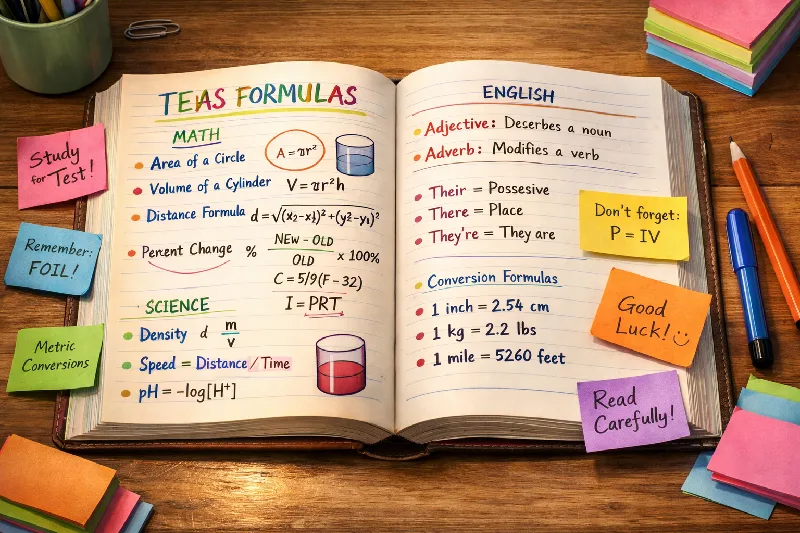
When many students enter the Science section, they have the notion that it is all about anatomy terms, body systems, and memorization of definitions. The fact is that a substantial portion of this part also checks science reason, chemistry calculations, simple physics, and simple unit conversions, and thus neglecting the mathematical aspect can cost one an easy mark.
This is precisely the reason why learning TEAS science formulas ought to become a component of any intelligent study process. Density and force are the same equation; temperature change and metric units are alike; these equations keep reoccurring and you will save time and confidence on the examination day just because you can recall them.
This is also applicable to TEAS science conversions, particularly the metric and temperature conversions, which may be reflected in both the Science and Math portions. This guide provides you with a practical, easy-to-memorize formula sheet so that you can answer questions more quickly, make fewer mistakes, and gain confidence to pass the TEAS science section. Even though you may think that right now is the TEAS exam hard right now, you are slowing yourself down.
Essential Chemistry Formulas for the TEAS
There is a tendency for chemistry questions on TEAS to be formula-based, but most predictable. Once you have a couple of concepts that are repeated, the section is a lot easier.
Density Formula
The most prevalent chemistry equation is:
Density = Mass ÷ Volume
A sample question will provide you with 20g of an unknown substance in 5 mL and require the density. The solution is 4 g/mL.
This is among the most reiterated TEAS science formula hence it ought to be automatic in your TEAS science prep.
Atomic Mass and Neutrons.
The other relationship that one must know is:
Mass Number – Protons = Neutrons.
For example:
- Mass number = 23
- Protons = 11
- Neutrons = 12
It is a speedy recall formula, which is often found in elementary chemistry problems.
Balancing Equations
You need not go to any great calculations, but you must bear in mind the Law of Conservation of Mass:
Reactants = Products
This implies that the atoms on one side of the equation should be equal to the atoms on the other side of the equation. This is the most logical concept of all TEAS science formulas, and it can be found most of the time when we go through the list of subjects on the TEAS.
The Metric System: The “King Henry” Method
Both science and math have metric conversions to learn, so time is saved in several sections by mastering TEAS science conversions.
The simplest memory device is:
King Henry Died with Drinking Chocolate Milk.
Use this order:
- Kilo = 1000
- Hecto = 100
- Deca = 10
- Base = gram, liter, meter.
- Deci = 0.1
- Centi = 0.01
- Milli = 0.001
The rule is simple:
- Right = decimal take right-turn.
Mn Move left = move in decimal to the left.
Example:
- 1 gram = 1000 milligrams
- Move three places right → 1.000 → 1000
Such TEAS science conversions can also be presented as dosage-type science questions, and are thus as important as core TEAS science formulas, particularly when taking a real TEAS exam format.

Qualified specialists
Temperature Conversions: Fahrenheit and Celsius
Temperature formulae are not very hard to remember, as students do not frequently use them. They are, however, very testable and need to be memorized word-for-word.
- Fahrenheit to Celsius
C = (F − 32) ÷ 1.8
- Celsius to Fahrenheit
F = (C × 1.8) + 32
- Kelvin
K = C + 273.15
Kelvin is less common, yet it is not in vain as a complete TEAS science prep.
Quick Tip
In case you forget the formula, you ought to remember:
- 0°C = 32°F
- 100°C = 212°F
This provides you with a quick estimate check point, as you solve TEAS science formulas, particularly when you are using a good TEAS study plan.
Physics Concepts: Energy and Force
Simple physics relationships can occasionally be found in the scientific rationale part. These are not so calculation-intensive and are recognition-based.
Kinetic Energy
This means:
- m = mass
- v = velocity
In case velocity is increased, kinetic energy goes up drastically since velocity is squared.
Potential Energy
Variables:
- m = mass
- g = gravity
- h = height
The taller an object is, the more energy that is stored.
Force
F = ma
When there is an increase in mass, but the acceleration remains the same, then the force also increases.
These recognition-based TEAS science formulas are frequently used in conjunction with TEAS science conversions in mixed reasoning questions, and most of the common mistakes students make are due to confusion of variables.
Biological Hierarchies and Ratios
Not all the formulas are numeric. Others are the structure memory chains, which serve as formulas.
Biological Organization
Remember that the order is as follows:
Atom -Molecule-Cell-Tissue-Organ-Organ System-Organism.
DNA Base Pairing
Always remember:
- A pairs with T
- C pairs with G
Mendelian Genetics Ratio
Punnett square: The most frequent outcome of a Punnett square is:
3:1 dominant to recessive
This is common in TEAS science prep,and such structural TEAS science formulastend to be easier to memorize when you study to prepare for the TEAS exam.
How to Memorize These Formulas Effectively
Formulas are best remembered when it is an active rather than a passive process of recall.
Employ the following action methods:
-
Flashcards
Make one deck of formulas that contains only science equations and hierarchies.
-
Morning Recall Drill
Memorize all the formulas in the mornings on plain paper.
-
There is only one problem with each formula.
Be able to solve at least one practice question per formula each day.
This practice enhances TEAS science conversionsand long-term TEAS science prep, particularly once practice test results are reviewed, to determine weak formulae.
Conclusion: Simplify Your Science Study
The TEAS Science part is quite general, whereas the math and formula part is quite predictable. When you can remember the density, temperature, force, energy, metric movement, and biological hierarchies quickly, you have saved precious time to tackle more challenging anatomy and reasoning questions.
Being able to master these TEAS science formulas and TEAS science conversions will provide you with a scoring advantage due to the same concepts being used in varying forms. Begin practicing these formulas now, and by the day of the test, they will have become automatic–either on the first attempt or when you have to retake the TEAS exam, and have been motivated by the success stories of other students.