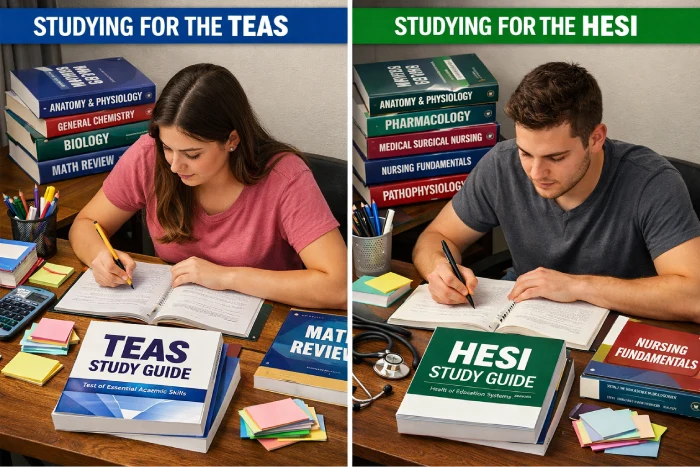
Choosing the right entrance exam is the first step toward admission to nursing school. Many healthcare students ask themselves, Is the TEAS or HESI harder to pass the first time around. With enrollments in 2026, programs have increased their competition, and you want to know which of these two exams you’ll need to pass.
While both tests assess your readiness for a rigorous healthcare curriculum, a head-to-head TEAS test vs HESI comparison shows the structural differences between the two tests. This guide details the format, questions, and scoring systems of both tests to help you determine which test best serves your needs.
Structural Breakdown: Core Variations in Exam Architecture
Many students entering the healthcare field ask, is HESI and TEAS the same exam under different names? The answer is no. They are both separate tests developed by different companies and based upon completely different testing strategies. The TEAS (Test of Essential Academic Skills) test is developed by ATI, and the HESI (Health Education Systems, Inc.) The A2 test is administered by Elsevier.
The main difference between teas and HESI is how the sections are laid out. The TEAS is a highly structured four-section exam that every student must pass in a certain order. The HESI, on the other hand, is a modular exam where your nursing school chooses which subtests you must take, and some have the option to skip sections like physics or chemistry entirely.
Here anyone can read, write & share short stories.
TEAS Structure: This exam has four sections comprising reading, mathematics, science, and English usage. All of these sections’ questions need to be completed, and there is no choice to leave the questions.
HESI Structure: In the HESI exam, schools have the freedom to choose the specific academic subjects according to the program. The typical subjects include physics, chemistry, biology, vocabulary, grammar, anatomy, and physiology.
Time Management: In the TEAS exam, there are strict time limits for sections and questions, but in the HESI exam, there is only the total time for the whole exam, and students can choose which questions they need to spend more time on.
Testing Feature
ATI TEAS Layout
HESI A2 Layout
Test Setup
Strict, fixed format with 170 total questions.
Flexible, modular format with up to 9 subtests.
Time Rules
Rigid time limits are enforced for each separate section.
One large countdown clock for the entire exam.
Subject Selection
You must take all four subjects regardless of the school.
Schools pick which specific subjects you must complete.
If you are stressed about how you will be able to manage the time in the exam, then you should take the TEAS practice test, as it can help you to practice time management for the whole exam and its sections.
Evaluating Content: HESI vs TEAS Difficulty in Science and Math
If you are comparing HESI vs TEAS difficulty levels for any class or subject, the science section usually weighs more heavily on most students. The science section of the TEAS is famous for being broad and challenging, as you have to answer tough questions on human anatomy, physiology, biology, chemistry, and scientific reasoning.
The HESI science sections tend to be a bit more focused on definitions and facts rather than on more critical thinking situations.
For the math section, the focus shifts. While the main focus in TEAS is on real-life algebra, fractions, percentages, and data analysis, questions in HESI math may include military time, Roman numerals, and basic household measurements, and this may pose a problem for students who have not memorized those conversion charts.
Step-by-Step Subject Comparison Checklist
Review the science depth: In the TEAS exam, the questions are extra detailed, but on the HESI exam, the questions are based more on definitions and rely on memorization.
Check the math requirements: for the TEAS exam, you must prepare for the algebra and fractions questions. For the HESI exam, focus more on basic healthcare math.
Analyze the reading format: In TEAS, there are long passage-based questions, and in the HESI exam, the focus is more on vocabulary and shorter reading sections.
Here anyone can read, write & share short stories.
English and Language Usage: Vocabulary vs. Grammar Mechanics
The main difference between the two tests occurs in their verbal sections. The TEAS English and Language Usage portion covers grammar, punctuation, sentence structure, and spelling. It assesses your ability to edit writing and understand technical terms in context.
On the flip side, the HESI puts a lot of emphasis on Vocabulary, which is not about test-taking grammar rules but rather about your actual knowledge of medical and healthcare terminology. If you enjoy reading definitions on flashcards, this is much easier to handle than analyzing large pieces of grammar layout.
Verbal Prep Strategy
Focus Area
Good Preparation Method
Bad Preparation Method
TEAS English
Review parts of speech, active/passive voice, and punctuation marks.
Memorize long lists of isolated medical dictionary definitions.
HESI Vocab
Study common prefixes, suffixes, and everyday healthcare terms.
Spend hours analyzing paragraph structure and editing flaws.
Question Layouts and Adaptive Features
Another reason that people think is HESI and TEAS the same test is that they use the same type of multiple-choice format. But the TEAS has other types of questions, such as “fill-in-the-blank,” “ordered response,” and “hot-spot” questions, where you must click on a particular portion of an image. These extra modes of questioning add complexity to the test.
HESI is easy to master because it uses simple multiple-choice questions. Because HESI lets you choose how much time you take across the various modules, you can skip easy sections like vocabulary in order to spare time for tougher math problems.
Question Style Comparison
Question Factor
TEAS Strategy
HESI Strategy
Question Types
Includes multiple-choice, drag-and-drop, and image hot-spots.
Mostly uses standard multiple-choice questions.
Navigation Rules
You cannot jump between different subject sections during the test.
You can move freely between assigned modules to manage time.
Scoring Impact
Unscored pretest questions are mixed invisibly into every section.
Contains extra pilot questions, but the format stays predictable.
Scoring Systems: How Your Final Points Are Calculated
Trying to determine is the TEAS or HESI harder to pass, you have to consider how your final scores are calculated. The TEAS uses Equated Percent Correct Scoring, which means your score will be adjusted for the difficulty of the test you took. It is much more difficult to miss a relatively easy question than to miss a more difficult one.
Unlike the HESI, the HESI uses a simple percentage scale from 0 to 100 percent for each section. Most nursing schools require a score between 75% and 80% on the HESI, whereas TEAS programs in their competitive arena typically expect scores over 80% on each section.
Simple Guide to Passing Scores
Metric
TEAS Goal
HESI Goal
Minimum Passing Target
Usually, a total score between 60% and 70% for entry.
Most schools expect around 75% to 80% on each module.
Competitive Nursing Target
Scores above 80% are often needed for top programs.
Scores above 90% are preferred for highly competitive schools.
Retake Restrictions
Many schools allow only two attempts per year.
Retake rules vary by school.
Let our subject specialists help you write your dissertation as per your requirements at significantly affordable prices!
For most students, the HESI is considered slightly easier because its questions are more direct and flashcard-based. The TEAS is often tougher due to its deeper science questions and strict, unyielding section timers.
Why do some students find the HESI harder than the TEAS?
Students who struggle with memorization often find the HESI harder. The HESI expects you to know specific facts, like military time conversions or obscure vocabulary definitions, whereas the TEAS relies more on reading comprehension and critical thinking.
Can HESI be easier than TEAS for some students?
Yes. If your nursing program only requires three or four HESI modules and lets you skip subjects like chemistry or physics, the test becomes significantly easier and faster to prepare for than the full-length TEAS.
Which exam is more predictable: TEAS or HESI?
The TEAS is much more predictable because the four-section layout never changes, regardless of where you take it. The HESI changes from school to school, so you have to check your specific college requirements to know what will be on your test.
Conclusion: Align Your Preparation with Your Exam
It all depends on how you think and what your nursing program requires. If you like broad thinking and managing time, the TEAS is for you. If you like direct memorization and a more flexible test format, the HESI is for you.
Either exam requires dedicated study and a detailed understanding of the test blueprints. If you are overwhelmed by the large-scale science requirements, then getting expert help can ease the strain.
Explore our professional Take my TEAS exam for me options today to secure your spot in nursing school and jumpstart your healthcare career.