
TEAS Fractions and Decimals Practice Questions
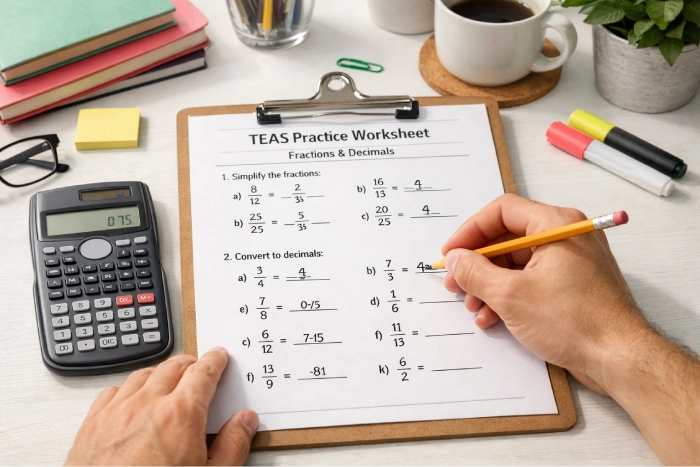
If you’re looking for TEAS fractions and decimals practice questions, you’re probably already deep into your Math section prep and realizing this is the topic that keeps tripping you up. You’re not alone; it’s one of the most common weak spots we see at Take My TEAS Exam, and the good news is that it’s also one of the most fixable. Below you’ll find real ATI TEAS decimals questions and fraction problems, each with a full step-by-step answer so you can actually see why the math works, not just what the final number is. Worth remembering: on test day, you only get a basic four-function calculator, so being comfortable doing this math by hand (or close to it) genuinely matters.
Why Fractions and Decimals Matter on the TEAS Math Section
Fractions and decimals are not a category of their own to know, learn by heart, and get over. They appear in word problems, in the ratio and proportion problems, and in the measurement conversion problems where you must change units in the middle of a problem. A question that requires the manipulation of objects instead of performing arithmetic may be a test of some other concept altogether, such as a ratio or a rate, and the arithmetic might fool you.
This is another reason why nursing programs place so much emphasis on this skill – dosage and medication calculations! If a nurse makes a mistake by taking 3/4 of a tablet or forgets to put the decimal point in the milligram dose, it is not a small mistake — it is an issue of patient safety. That’s one reason for the prevalence of fractions and decimals in TEAS numbers and algebra practice, and why programs rely on it as an early indicator of readiness to work with that level of precision. For those who wish to view this in the context of their prepping plan, we have a guide on building a 30-day TEAS study plan that actually works.
Key Rules to Remember Before You Start
Before we go into the questions, here is a quick refresher: This is not a full lesson, just the core TEAS math formulas fractions moves you’ll use over and over
Converting a decimal to a fraction: Write the decimal over 1 (so 0.6 becomes 0.6/1), then multiply top and bottom by 10, 100, or 1000 depending on how many decimal places you have, until the top number is a whole number. Then reduce.
Converting a fraction to a decimal: Simply divide the numerator by the denominator. 3/8 becomes 3 ÷ 8.
Adding or subtracting fractions: You need a common denominator first. Find the least common multiple of the two denominators, convert both fractions to that denominator, then add or subtract the numerators.
That’s all you’ll see in most of the toolkits. If any of these are shaky, it’s a good idea to go back over them properly before getting into practice; otherwise, you’ll pick up bad habits.
TEAS Fractions and Decimals Practice Questions with Answers
Converting Decimals to Fractions (Questions 1–3)
Question 1: Convert 0.125 to a fraction in lowest terms.
Answer: Write it as 125/1000. Both numbers are divisible by 125, giving you 1/8.
Question 2: Convert 0.6 to a fraction in lowest terms.
Answer: Write it as 6/10. Divide top and bottom by 2, and you get 3/5.
Question 3: Convert 2.75 to a fraction in lowest terms.
Answer: Separate the whole number: 2 + 0.75. The decimal 0.75 is 75/100, which reduces to 3/4. So 2.75 = 2 3/4, or as an improper fraction, 11/4.
Converting Fractions to Decimals (Questions 4–6)
Question 4: Convert 3/8 to a decimal.
Answer: Divide 3 by 8. 3 ÷ 8 = 0.375.
Question 5: Convert 5/6 to a decimal.
Answer: Divide 5 by 6. 5 ÷ 6 = 0.8333…, which rounds to 0.83.
Question 6: Convert 7/20 to a decimal.
Answer: Divide 7 by 20. 7 ÷ 20 = 0.35.
Add and Subtract Fractions with unlike denominators (Questions 7–9)
Answer: LCD of 3 and 4 is 12. Convert: 1/3 = 4/12 and 1/4 = 3/12. Add the numerators: 4/12 + 3/12 = 7/12.
Question 8: Subtract 1 3/4 from 2 1/2.
Answer: Convert to improper fractions with a common denominator of 4: 2 1/2 = 10/4, and 1 3/4 = 7/4. Subtract: 10/4 − 7/4 = 3/4.
Question 9: Subtract 1/3 from 5/6.
Answer: 6 is the common denominator. Convert 1/3 to 2/6. Subtract: 5/6 − 2/6 = 3/6, which reduces to 1/2.
Multiplying and Dividing Fractions and Decimals (Questions 10–12)
Question 10: Multiply 2/3 × 3/5.
Answer: Multiply straight across: (2 × 3)/(3 × 5) = 6/15. Reduce by dividing top and bottom by 3, giving 2/5.
Question 11: Divide 4/5 ÷ 2/3.
Answer: Dividing fractions means multiplying by the reciprocal, so flip the second fraction and multiply: 4/5 × 3/2 = 12/10, which reduces to 6/5, or 1 1/5.
Question 12: Multiply 1.2 × 0.05, then divide 0.75 ÷ 0.25.
Answer: For the multiplication, ignore the decimal points and multiply 12 × 5 = 60. Count the total decimal places in the original numbers (one in 1.2, two in 0.05, so three total) and place the decimal three spots from the right: 0.060, or 0.06. For the division, move the decimal point in both numbers until the divisor is a whole number: 0.75 ÷ 0.25 becomes 75 ÷ 25 = 3.
Word Problems Combining Fractions and Decimals (Questions 13–15)
These TEAS fraction word problems combine the concepts of conversion and operations in an applied, real-world context — just like you’ll see on test day!
Question 13: A recipe calls for 2/3 cup of sugar for 4 servings. How much sugar is needed for 6 servings?
Answer: Set up a proportion: 2/3 cup ÷ 4 servings = x ÷ 6 servings. Multiply 2/3 by the scaling factor (6/4, which simplifies to 3/2): 2/3 × 3/2 = 6/6 = 1. You’ll need 1 cup of sugar.
Question 14: A patient’s chart lists a dosage of 3/4 tablet, taken twice daily. How many tablets, expressed as a decimal, does the patient take per day?
Answer: Multiply 3/4 by 2: 3/4 × 2 = 6/4, which simplifies to 3/2, or 1.5. The patient takes 1.5 tablets per day.
Question 15: A patient walked 2.4 miles on Monday and 1 3/4 miles on Tuesday. What was the total distance walked?
Answer: Convert 1 3/4 to a decimal: 3/4 = 0.75, so 1 3/4 = 1.75. Add: 2.4 + 1.75 = 4.15 miles.
Feeling good about these? Try a full-length online TEAS practice test to see how fractions and decimals show up alongside everything else on the Math section.
Common Mistakes with Fractions and Decimals on Test Day
Some patterns appear repeatedly in students’ incorrect responses on this portion:
- Not detecting the common denominator before adding and subtracting fractions, thus changing the answer.
- Losing track of decimal places when multiplying and dividing decimals — use decimal places or estimate to double-check.
- Not reducing fractions to lowest terms, which can make a correct answer look like it doesn’t match any of the answer choices.
- Solving word problems without stopping to determine the final unit of measure (such as “cups” vs “tablespoons” or “tablet” vs “milligrams” etc.).
Most of the careless errors that cost points that people actually knew how to earn can be avoided by slowing down on each of these checkpoints for a few extra seconds.
Quick Mental-Math Tricks (No Calculator Needed)
Doing TEAS math without a calculator for fractions and decimals sounds intimidating, but since you won’t have a calculator that handles fractions for you anyway, a little memorization goes a long way. Commit these common fraction-decimal equivalents to memory: 1/2 = 0.5, 1/4 = 0.25, 1/8 = 0.125, and 1/3 ≈ 0.33. Recognizing these instantly saves you from doing long division mid-test.
It also helps to estimate before you calculate. If you’re multiplying 0.48 by 3, round to 0.5 × 3 = 1.5 first, so you know your exact answer should land somewhere close to that — a quick sanity check that catches decimal-point errors before you commit to an answer choice.
If speed is your main obstacle, our full breakdown on how to solve TEAS math problems quickly without a calculator goes deeper into these kinds of shortcuts.
Frequently Asked Questions
Are fractions and decimals a big part of the TEAS math section? Yes. Fraction and decimal conversions and operations are core skills under the TEAS Math section’s Numbers and Algebra content area, and they often appear embedded in word problems as well as standalone questions.
Can I use a calculator for fraction and decimal questions on the TEAS? You’re given a basic four-function calculator, which handles simple arithmetic but won’t simplify fractions or convert between formats for you — so knowing the manual steps is still essential.
What’s the fastest way to convert a fraction to a decimal? Divide the numerator by the denominator. For common fractions like halves, quarters, and eighths, memorizing the decimal equivalents in advance saves valuable time on test day.
Why do TEAS fraction questions sometimes feel like word problems? The TEAS often embeds fraction and decimal skills inside applied scenarios, like measurement or recipe conversions, to test whether you can actually apply the math rather than just recognize it in isolation.
How can I improve quickly if fractions and decimals are my weakest area? Drill a focused set of practice questions daily, memorise key conversions, and consider creating a personalised study plan that focuses your remaining prep time on this specific weak spot.

Qualified specialists
Final Thoughts
Fractions and decimals are one of the most daunting concepts to learn because they appear all over the TEAS Math section, and it’s also one of the most potentially helpful concepts that you can learn. The rules have been updated, and you’ve got 15 practice questions that are worked out step by step, with a solid foundation to continue building on. If this session reinforced your belief that fractions and decimals are a real Achilles’ heel, you can make a personalized TEAS study plan based on your weak areas, thereby using the time you have left to your strong ones.
Of course, if you prefer expert assistance to help you along the way, our TEAS exam tutoring services can be of assistance — or if you’re looking for more comprehensive exam support, see our pay someone to take my exam page. Have questions about any of this?Contact us — we’re happy to help you figure out the right next step.