
How to Use Short Study Sessions for TEAS Preparation
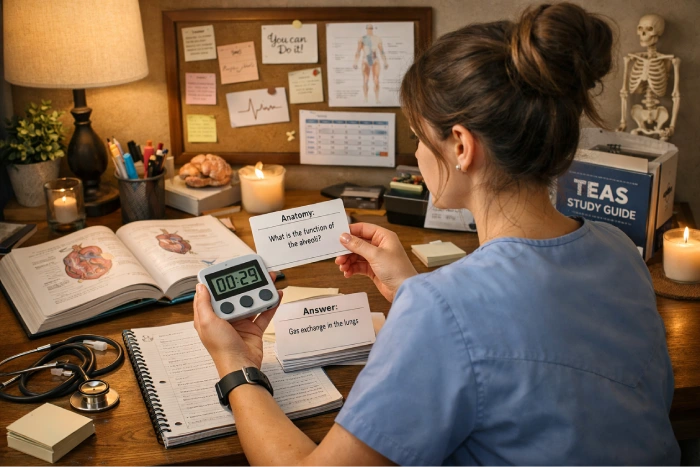
Study sessions can be effective for TEAS preparation if each study session is brief and uses active recall, one skill per session. For a busy nursing applicant, it’s more likely to be possible to study for 10-15 minutes a day (on a schedule that fits) than a two-hour block of time that never fits.
This method works well in the context of work, clinicals, parenting, and other areas. Don’t use short sessions to take the place of longer practice sessions, but can be used to maintain preparation over the week. This will help you on how to plan your TEAS exam study timeline in a way where you can incorporate both strategies.
Why Short Study Sessions Work (The Actual Research)
Microlearning is made up of shorter learning activities, not to the exclusion of longer learning blocks. Studies in health-professions education have shown that it is possible to achieve less knowledge in more comprehensive learning sessions without necessarily having to compromise knowledge outcomes.
This is applicable to TEAS students as many are preparing for healthcare careers where focused learning is already commonplace. It’s better to spend an hour on a session of active recall than an hour of passive revision, or to spend 10 minutes actively recalling information.
It’s what you do within those minutes that’s important. Short study sessions should focus on recall, recalling information, questions, or correcting errors, or on practising a particular skill.
When a Short Session Is Enough (And When It Isn’t)
Short sessions are good for review of information or for a very specific skill. They are not good for work which demands prolonged attention.
For short sessions, do:
- Flashcard review
- One Math skill
- Formulas/conversions from science
- Missed practice questions
- Grammar rules
- Vocabulary recall
All tasks do not require a short session. A larger quantity of practice tests (full-length tests) will require longer time, and new or tough concepts will need more teaching and more examples.
The optimal strategy is to use both formats. If the weekdays are busy, consider using short sessions for those days, and longer sessions for those days when you can do full practice tests or work on hard stuff. A guide on how to build a 30-day TEAS study plan that actually works will help you out.
A TEAS Short-Session Menu by Section
The easiest way to implement short study sessions for TEAS preparation is to have one objective for each study session.
Reading: 10 Minutes
Develop answers to 5-6 questions focusing on a skill (inference, fact versus opinion, author’s purpose). Then, in the remaining time, review any answers that you missed, explaining why.
Math: 10–15 Minutes
Use one skill, rather than a mixture of skills and tasks. Do 5 “proportion problems”, or 5 one-variable equations.
When you continually keep getting the same problem, concentrate your next session on that step – not another step.
Science: 10 Minutes
Go over one body system, a section of scientific words, or several formulas and/or conversions. Try to quiz yourself before looking at your notes. To review TEAS science formulas and conversions you must memorize, use this as a reference guide.
English and Language Usage: 10 Minutes – 10 points.
Answer approximately 10 grammar and/or usage questions. Only review the rules pertaining to the errors made; then retest.
This makes it easy to form a simple circle of question, error, correction, and recall. For a more targeted approach, consider how to create a personalized TEAS study plan based on your weak areas.
How to Fit Short Sessions Around Clinicals, Shifts, and Family Time
The most effective method to make brief sessions effective is to couple them to anticipated breaks in your day. It’s not necessary to have a big block of time to set aside.
Useful opportunities include:
- Work breaks
- Wait time between clinical activities
- When driving, avoid commuting time
- Waiting rooms
- 10 minutes before going to sleep at night
- Parents, family, and children are not always in sync.
Have flashcards or practice questions handy to begin practicing right away. There is also the option of several small sessions, which can be run throughout the day.
For instance, you’ll be able to devote 10 minutes to science in the morning, 10 minutes on a work break to Math, and 10 minutes in the evening to Reading.
Making Short Sessions Actually Effective (Not Just Short)
A short session is not particularly helpful unless the session is the focus of an activity and is active. A ten-minute review of notes without self-testing will not be as beneficial.
Use these habits:
- Active Recall: Test yourself; do not re-read.
- One Topic: Do not combine unrelated skills.
- Immediate correction: Immediately go over missed answers.
- Spaced reviews: Review topics that are difficult later on.
- Document errors: Make a list of frequently occurring errors.
Your error log may be your study plan! If you are continuing to lose ratio questions, then, for the next Math session, focus on ratios, not a different random set of questions.
This helps with microlearning TEAS study to be more focused on weaknesses, as each study session is based on actual weaknesses.
FAQ
Q: Are short study sessions actually effective for TEAS prep?
Yes. Short sessions can be very effective in reinforcing TEAS skills if they are about a single topic and use active recall. Research in microlearning also supports learning in a focused way for knowledge retention.
Q: How long should a TEAS study session be?
Flashcards, 1 skill/f formulas, or missed questions – 10-15 min. is good. This will require longer sessions for full-length practice tests.
Q: Can I pass the TEAS studying only 10–15 minutes at a time?
The number of short sessions can be used in a way that builds skills up consistently; however, periodic longer sessions are recommended. Pacing, stamina, and experience of actually taking a test are developed by using full-length practice tests.
Q: What should I study in a 10-minute TEAS session?
Select ONE very specific task, e.g., 5 Math problems, some questions about Reading, 1 Science topic, a quick grammar review. Don’t teach more than one content area.
Q: How do I fit TEAS studying around clinicals or work shifts?
Take advantage of breaks and anticipated gaps to work on specific skills. Have notes and other study resources handy and study in small chunks throughout the day.

Qualified specialists
Closing CTA Guidance
Being able to study for hours each day isn’t necessary to be productive while preparing for TEAS. The quick, concise sessions will help you strengthen weak skills without consuming all your time or on-site hours, and can be scheduled around your work, clinical, and family duties. To further prepare, check out TEAS exam tutoring services or online TEAS practice tests. Take My Teas Exam is there to help you with more assistance as well.