
TEAS Reading Practice Questions With Detailed Solutions
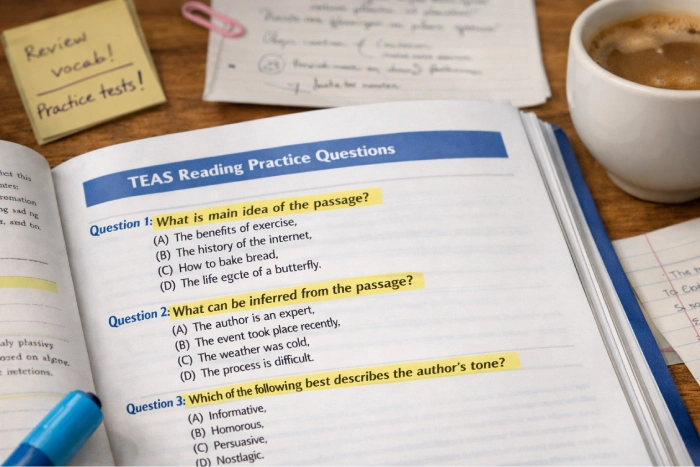
Successfully passing the TEAS exam means getting into your desired nursing program, but the process is not as easy as it sounds. TEAS is divided into four main areas: Reading, Math, Science, and English. Each area holds value and weight, but this post is focused on the reading section only. So, is TEAS reading hard? Well! Preparing for it is definitely an intimidating experience in the beginning, but it gets easier with the inclusion of practice questions and the right strategies.
One easy and straightforward solution for how to answer TEAS reading questions is through practice tests. These tests teach you how to analyze information fast, understand its meanings, and answer correctly without difficulties. The TEAS Reading practice questions mimic the format of the actual test, thus giving you the opportunity to practice on your own gradually and get better results in your future exams. This post explores more about these practice questions, the number of such questions in the test, their resemblance to the actual test, and some solving techniques.
What Are TEAS Reading Practice Questions?
The purpose of TEAS Reading section practice tests is to provide specific exercises that allow students to prepare for the reading section of the test. They include both short and long passages accompanied by multiple-choice questions that assess comprehension, reasoning, and attention to detail. When you practice regularly, you start recognizing patterns within passages, questions, and methods for solving them correctly. Thus, speed and accuracy are guaranteed through the process of practice.
Why Are TEAS Practice Questions Important?
Practice questions are just like exercise questions, but even closer to the real test format. TEACH practice questions enable candidates to gain experience in answering questions as well as learning how to search for answers in passages efficiently. It is said that if you manage to pass TEAS reading section practice test, then you can pass the actual exam as well. This practice test is important because it:
- Enhances your reading speed and comprehension.
- Prepares yourself to answer on exam day.
- Helps you pinpoint weaknesses.
- Instructs you in time management techniques.
- Develops your understanding of vocabulary.
These features make practice questions among the most useful TEAS reading study aids.
Kinds Of TEAS Reading Practice Passages
TEAS Reading practice materials feature different types of passages similar to those that appear on the actual test. The purpose of each passage type is to develop different skills in students and prepare them efficiently for the nursing exam. The TEAS reading section practice test usually involves the following kinds of passages, just like the real test:
- Informational passages; these include the assessment of facts, sciences, or health-related topics.
- Literary passages; these passages are presented in the form of narrative stories or short stories.
- Workplace passages, including email messages, announcements, and instructions.
- Passages that combine information and explanations.
All these passages prepare students for real TEAS exams as well as for real-world situations.
Skill Tested By TEAS Practice Questions
These practice questions not only test your ability to comprehend the texts but also test your logical and critical thinking skills, by asking you to find:
- Main idea and details of the passage.
- The purpose of the author behind the passage.
- Drawing inferences from the text.
- Tone and meaning of the passage.
- Comparison of information provided in the passage.
Wondering how to pass TEAS reading section? The answer lies in constant practice, as one can master all the analytical skills required for reading comprehension through practice. Explore TEAS exam practice questions for the best preparation. It can easily be said that TEAS Reading practice questions are very helpful tools that teach students how to analyze texts rather than simply reading them.
How Many Questions Are In The TEAS Reading Section?
The total number of TEAS Reading questions is fixed, with each of these questions assessing different kinds of reading skills. Understanding the structure of the test helps students to save time during the examination, which is something like:
- Number of total reading questions: 45–50 questions.
- Most questions: based on passages.
- Types of questions: main idea, inference, vocabulary, and analysis questions.
- Time needed: about 55–60 minutes.
- Reading difficulty: from very easy to very hard.
Each of these questions assesses students’ understanding of given texts within certain time frames. While some questions might appear rather straightforward, some would need much time to compare several aspects of the passage content. One can safely excel through all these questions within the given time span by getting online TEAS test assistance.
It might be quite challenging for students to answer all the given questions on time and complete them on their own if they are not prepared well enough. Students should try to develop skills to read texts quickly without losing their understanding of the concepts. In conclusion, the TEAS Reading section is structured to test students’ understanding as well as time management, making preparation essential for excellent performance.
Are TEAS Reading Practice Questions Similar To The Real Exam?
The TEAS Reading practice questions are extremely similar to the actual test since they use the same structure, types, and difficulty level as the TEAS reading test. Hence, preparing with practice questions gives you a clear idea of what to expect when you do the real test. How to pass TEAS reading section? You can do that by beginning to understand the structure of the test.
Usually, practice questions for the TEAS Reading test use the same criteria of creating the TEAS reading passages as set by the test creators. Thus, you encounter the same type of passages in the practice test as the real one, including informative passages, workplace documentation, or literature samples.
Some practice tests might be easier or more difficult than the real one depending on who creates them. Therefore, using good practice material for preparation is essential. The following table explicitly compares the TEAS practice test format and the real exam format:
| Feature | Practice Question | Real TEAS Exam |
| Passage Types | Informational, Literary, Workplace | Same types of passages |
| Difficulty Level | Varies by source | Balanced and standardized |
| Question Style | Multiple Choice | Multiple Choice |
| Time Pressure | Sometimes Flexible | Strict Time Limit |
| Purpose | Learning and Practice | Final Evaluation |
Even though TEAS practice tests are not the exact exams, but they are extremely close in structure, as well as logic. This makes them one of the best tools for preparation.
In short, students who consistently practice with TEAS-style questions are usually much more comfortable and confident during the real exam, which helps them earn better grades.
What Is The Best Strategy For Answering Reading Comprehension Questions?
The success in answering TEAS Reading test questions mostly depends on your strategic skills rather than on how much knowledge you have gained by memorizing facts. Obviously, understanding the concepts is important, but you cannot solely rely on them to pass the TEAS exam.
The best strategy to answer the Reading comprehension section accurately and in a timely manner is to begin by reading the questions before the given text. It gives you a hint about the necessary information that you should pay attention to in the text. You can do that effectively in the following ways:
- Read questions before the passage to set focus.
- Skim through the passage to get the main idea.
- Highlight the keywords as you read the text.
- Firstly, eliminate answer choices which you find clearly wrong.
- If necessary, use contextual clues to understand words.
- Never spend too much time on one question.
After that, it is important to keep track of the time. If a question seems to be hard to solve, skip it and answer it later in case you have some time left.
Besides, make sure that you provide no personal opinions in the process of answering. The answers you choose should be based exclusively on the evidence provided in the text, without any bias from your side.
And lastly, do practice under time constraints regularly. It will help you build up skills in terms of both time management and answering skills. In conclusion, the mentioned strategies are helpful when trying to pass TEAS Reading test questions.

Qualified specialists
Why Does Studying Solutions Improve Learning for Students?
Studying solutions rather than just verifying that your answer is correct can benefit many students in improving their learning processes. In-depth explanations provide insights into why the right answer was chosen and why all other answers were wrong. It enables students to get insight into how the thought process works regarding TEAS Reading problems. In the end, they learn to spot patterns and mistakes.
Conclusion
The TEAS Reading practice questions prove to be extremely useful for the success of the students in the test. These questions give insight into the type of questions asked in the test, the style of passages, and the necessary skills required to get the answers. Regular practice makes students faster readers and thinkers.
These students also gain confidence because they have learned everything about the number of questions asked, the nature of those questions, and the likeness of those questions to that of the actual test. The most important thing is the application of the appropriate strategy that makes it very easy and convenient to answer questions.